
Mia – Nowhere

Main Character Modeling for a Collaborative Short Film

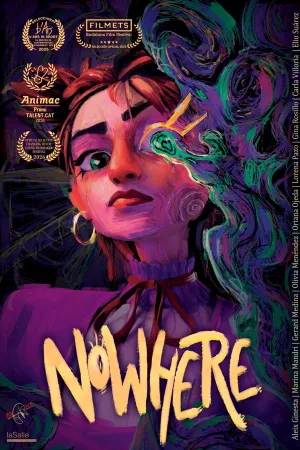
Mia is the lead character of Nowhere, a collaborative animated short film produced by MadDuck Studios.

The story follows a young artist struggling with creative block and impostor syndrome. Because much of that conflict is internal (and the short itsef is silent) Mia’s expressions, posture and gestures needed to communicate what she could not put into words.

Starting from an early sculpt proposal, I worked on developing her final character model, with particular attention to the face, hands, hair, retopology and UV layout. The aim was to preserve the appeal of the original design while preparing a reliable asset for animation, texturing and lighting.

You can follow the team on instagram: @nowhere.short.film
Goal

Mia needed to feel fragile and expressive without relying on an exaggerated or obviously sad design. Her costume defines much of her overall silhouette, so the face, hair and hands became especially important. They needed enough clarity to carry subtle animations and remain readable both in close-ups and under the film’s stylized look.

My goal was to strengthen those areas while keeping the character visually cohesive and preparing the model for the needs of the following departments.

Process

1. Character Development

Starting from an early sculpt proposal, I worked on developing Mia’s final model. I worked on all the body parts, while Gerard Medina worked on the clothes.

I focused especially on the face and hands, refining and pushing their shapes and proportions while keeping the stylized design consistent. I also created the eyes, eyelids, eyebrows, mouth and teeth, preparing the facial elements required for the following production stages.

2. Hair

The hair was one of the main challenges of the character. Its distinctive design gives Mia much of her personality, so preserving the shapes of the concept was especially important.

The hairstyle combines two small pigtails, a fringe and longer hair falling down the back, which made balancing the different sections quite complex. I built it using hair clumps of different sizes, refining how they overlapped and connected so that the hairstyle felt cohesive and remained readable from every angle.

4. Retopology & UV Mapping

Once the sculpt was approved, I created the final topology in Maya. I used Zuri’s final topology as a starting point, wrapping it onto Mia and then adjusting the edge flow to fit her proportions and features. This allowed me to reuse an already tested topology while making sure the main shapes were preserved and the face could support the expressions and deformations required for animation.

Finally, I prepared the UVs, organising the different parts with consistent texel density and a clear layout to keep the asset easy to manage throughout texturing and the following stages.

What Helped Me Most

A few ideas from this project have stayed with me and continue to influence how I approach character work.

  • Plan complex hairstyles before sculpting.
    Mia’s hair became much easier to manage once I planned how it grew, how the main sections were distributed and how each shape contributed to the silhouette. Organising the hairstyle into clumps of different sizes helped me balance the forms and avoid unnecessary visual noise.
  • Focus the work where it will make a difference.
    Large parts of Mia’s body are always covered by her oversized clothing, so perfecting the anatomy of areas such as the shoulders, clavicles, waist or feet would not have improved the final result. Understanding what would actually be visible allowed me to prioritise the face, hands, hair and other areas that mattered most on screen.

    Software

    ZBrush · Maya · Wrap3D · Arnold

    Credits

    • Character Modeling: Laura Blázquez, Gerard Medina, Carla Villoria
    • CFX: Gerard Medina
    • Production: MadDuck Studios

    Need stylized, production-ready characters for film, games or cinematics?