Why Every Technical Decision Should Have a Narrative Intention
In 3D production, technical decisions are never neutral. Even when they’re made for optimization, performance or pipeline reasons, they always affect how a scene reads. Through my projects, I’ve learned that scenes become stronger and production becomes smoother when technical choices are guided by narrative intention from the start, not added as an afterthought. This post explains how I approach that balance, using practical examples from a lighting study inspired by The Legend of Zelda.
Technique and storytelling are not separate
It is common to think in two phases: first make it work, then make it look good. In practice, this separation often creates problems, because technical decisions actively shape storytelling.
For example:
- Lighting structure defines mood and emotional tone
- Level of detail affects clarity and visual hierarchy
- Material response changes how believable a scene feels
- Scene complexity controls where the viewer’s eye goes
A scene can be technically correct and still feel unfocused if those decisions are made without a clear narrative goal.
A real project example: Zelda & Link lighting study
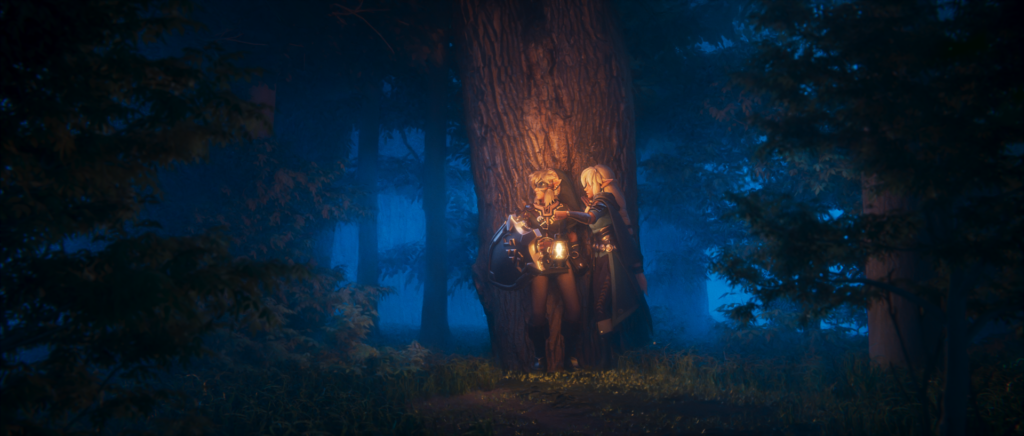
In my Zelda & Link: Magical Forest Lighting Study, the focus was not realism alone, but the balance between believable lighting and narrative intention.
The scene is set in a quiet night-time forest inspired by The Legend of Zelda, designed to communicate intimacy and connection through light, without dialogue or animation.
Before touching technical settings, I defined the narrative goals:
- Focus attention on the relationship between the characters
- Balance realism with a stylized emotional atmosphere
- Preserve softness, mystery and depth in a dense forest environment
Key decisions during the process
Layout and composition
- Camera, characters and key assets were positioned to frame the emotional axis: the line of sight between Link and Zelda
- Negative space was carved to reduce visual noise
- A basic lighting hierarchy was already considered at layout stage to define narrative flow
Lighting setup in Maya and Arnold
- A warm lantern served as the primary key light, establishing the focal point of the scene and drawing attention to the interaction between the characters.
- Cool moonlight was introduced as a secondary source, providing contrast, shaping the environment and reinforcing the night-time atmosphere.
- Soft ambient fills helped reveal form and depth while preserving the scene’s mood.
Rendering and compositing
- Clean AOVs were generated for full artistic control
- Passes were integrated in NukeX with careful exposure balancing and color grading
- Subtle fog and depth cues enhanced distance and atmosphere
The result was a scene that felt calmer, clearer and more emotionally focused, while remaining technically solid and production-ready.
This is what narrative intention means to me. Not forcing story elements everywhere, but making decisions with purpose. By defining what matters early, technical choices become clearer and less reactive later in the process.
Why this mindset matters in professional production
Narrative intention is not only a creative tool. It also improves production efficiency.
When priorities are defined early, decisions become easier to make, iterations become more focused and scenes remain cleaner throughout development. Instead of solving problems reactively, artists can evaluate choices against a clear objective.
In production environments, technical skills create the most value when they support a defined goal. That alignment between intention and execution helps projects move forward more efficiently while maintaining visual coherence.
For other artists: intention actually speeds you up
Early on, I assumed planning would slow me down. In practice, the opposite happened. Taking a few minutes to define what I wanted a scene to communicate reduced hesitation, prevented unnecessary revisions and made decision-making much faster. When you understand why you are making a decision, you hesitate less and stop overworking areas that do not really matter.
You don’t need to master every tool or technique to work efficiently. What truly makes the difference is understanding the impact of your choices and how they affect the scene as a whole. That clarity allows you to move forward with confidence and speed, instead of constantly second-guessing yourself.
Personal reflection
The scenes I struggle with most are rarely failing because of technical limitations. More often, they suffer from a lack of direction. When intention is defined early, technical decisions become clearer, production becomes smoother and final polish feels like refinement rather than correction.
You can see how this approach translates into real work in my project case studies, where I break down key decisions step by step and explain why they were made.